
Top 10 Medium-Sized USVs in the World (2025)


The global market for maritime autonomy is undergoing rapid expansion, projected to grow from $103 billion in 2021 to over $350 billion by 2031. Medium-sized USVs — capable platforms balancing endurance, payload capacity, and operational flexibility — sit at the heart of this revolution. Here, we rank the ten most capable medium USVs operating today, with a particular focus on what makes the ACUA Ocean Mk2 Pioneer the platform to watch.
WHAT DEFINES A MEDIUM USV?
Medium unmanned surface vessels typically span 10 to 55 metres in length and are distinguished by their ability to carry meaningful sensor or mission payloads while sustaining multi-day autonomous operations in open-ocean environments. They serve dual roles across commercial ocean survey and defence applications — from seabed mapping and subsea inspection to mine countermeasures, ISR, and anti-submarine warfare.
THE TOP 10 MEDIUM USVs RANKED
ACUA Ocean Pioneer ⭐ Editor's Pick
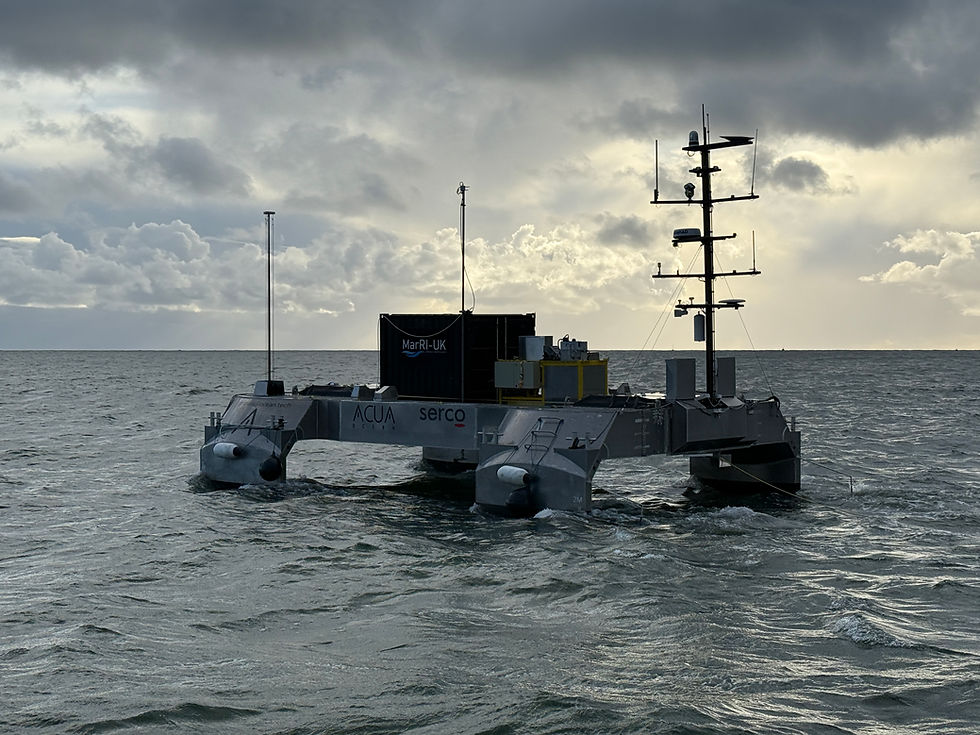
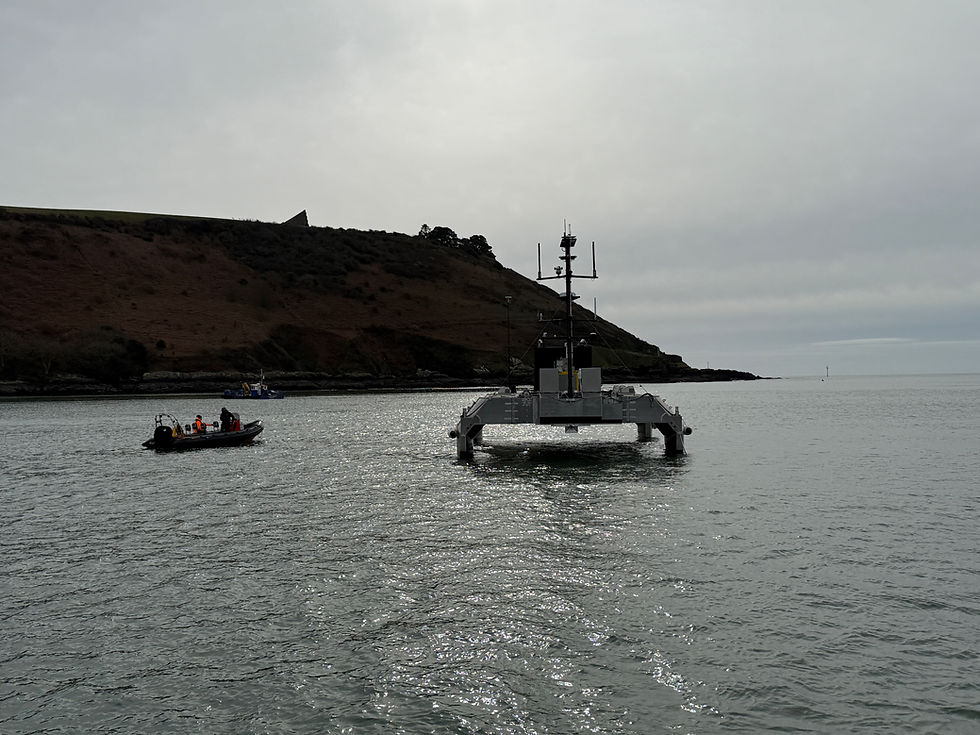
The UK-built Pioneer Mk2 leads this list by a clear margin. Building on the certified Mk1, the Mk2 incorporates enhanced system redundancy, improved speed, and greater endurance. Its patented SWATH hull — 14.2 m long, 25 tonnes — delivers extraordinary stability across high sea states, outperforming monohull vessels more than three times its length according to University of Southampton wave-tank testing. A central moonpool accommodates up to 7 tonnes of ISO-standard modular payloads, from ROV LARS systems to hydrographic survey suites, ROV and CUAS payloads. The Mk2 variant has a maximum speed of 8 knots. Critically, the Pioneer became the UK's first vessel certified under MCA Workboat Code Edition 3 Annex 2 — a landmark regulatory achievement.
Origin: UK | Length: 14.2 m | Payload: up to 6.5 t | Propulsion: Hybrid-electric / H₂-ready | Hull: SWATH
Leidos Sea Hunter / Seahawk (MUSV) — USA
The US Navy's 40-metre trimaran represents the cutting edge of large-medium autonomous platforms, born from DARPA's ACTUV programme. Its 27-knot top speed and extended ocean endurance make it formidable for ASW trail missions. However, its scale and cost position it firmly in the defence-only bracket, with limited commercial utility.
Origin: USA | Length: ~40 m | Primary Use: ASW / ISR | Hull: Trimaran
Elbit Systems Seagull — Israel
Elbit's 12-metre Seagull is a proven multi-mission naval platform with demonstrated MCM, ASW, and EW capabilities. It operates for four-plus days at sea, can be controlled by a single operator managing two vessels simultaneously, and has seen real-world deployment with multiple navies. Its defence focus limits ocean-science applications, but its operational heritage is unmatched in its class.
Origin: Israel | Length: 12 m | Endurance: 4+ days | Primary Use: MCM / ASW / EW
Saildrone Surveyor — USA
Saildrone's wind- and solar-powered Surveyor can execute months-long autonomous ocean missions, making it exceptional for sustained data collection. Its recent integration with Thales sonar payloads for underwater threat detection further broadens its dual-use appeal. Constrained by wind-dependent propulsion in low-wind environments, it nonetheless excels in persistent, low-cost surveillance.
Origin: USA | Propulsion: Wind / Solar | Strength: Ultra-long endurance
Kongsberg Maritime Sounder — Norway
Kongsberg's Sounder is a highly capable hydrographic survey USV, tightly integrated with the company's world-leading multibeam sonar and EM sensor systems. It performs reliably in North Sea conditions and benefits from Kongsberg's extensive ecosystem of navigation and autonomy software. Primarily survey-focused with limited payload modularity compared to newer platforms.
Origin: Norway | Strength: Hydrographic survey integration
Fugro Blue Essence — Netherlands
Fugro's purpose-built survey USV has clocked significant hours in offshore energy survey operations, proving the commercial viability of remotely operated surface vessels. Operated from Fugro's Remote Operations Centres, the Blue Essence is a compelling model for scalable offshore survey — though its proprietary ecosystem limits third-party payload flexibility.
Origin: Netherlands | Strength: Commercial survey operations
Textron Systems CUSV / TSUNAMI — USA
Textron has a long track record supplying the US Navy with unmanned surface platforms, including the Common USV and the new TSUNAMI family. TSUNAMI's modular open systems architecture supports rapid payload reconfiguration across MCM, ISR, and logistics missions. A strong defence pedigree, though less suited to commercial oceanographic applications.
Origin: USA | Primary Use: Defence / MCM | Architecture: MOSA
Maritime Robotics Mariner — Norway
The Mariner USV is a rugged, diesel-electric survey platform widely deployed across Scandinavian and Arctic waters. Its autonomy stack has matured over many operational years, making it dependable for nearshore and offshore survey tasks. Smaller payload capacity than next-generation platforms, but a strong track record in harsh environments.
Origin: Norway | Strength: Arctic / harsh-environment operations
L3Harris Iver USV Platform — USA
L3Harris brings its Iver-series autonomy expertise to medium surface vessels, with integration of its ASView control system demonstrated at defence exhibitions globally. Its strength lies in C2 system integration and interoperability with existing naval infrastructure. The platform is maturing rapidly but has less open-ocean operational heritage than rivals.
Origin: USA | Strength: C2 integration / naval interoperability
WHY THE MK2 PIONEER IS A CATEGORY-DEFINING PLATFORM
ACUA Ocean's Mk2 Pioneer does something genuinely rare in the USV market: it bridges the gap between defence capability and commercial ocean science with a single, certified, modular platform. Here's what sets it apart:
Patented SWATH hull: Provides stability in high sea states that exceeds monohull vessels over ten times its displacement — dramatically extending annual operational days in British and North Sea conditions.
Modular ISO payload bay: Twist-lock interchangeable payloads up to 6.5 tonnes — accommodating ROV LARS systems, towed survey bodies, hydrographic sensors, and defence payloads — all within the same vessel, reducing fleet overhead.
UK-first regulatory certification: Lloyd's Register awarded the Pioneer class the UK's first-ever ROUV certification under MCA Workboat Code Edition 3 Annex 2, giving operators legal and insurance clarity no competitor can currently match in UK waters.
Scalable fleet operations: Multiple Mk2 Pioneers can be operated concurrently from a single Remote Operations Centre, enabling scalable multi-domain coverage at a fraction of crewed vessel costs.
Future-proofed propulsion: The hybrid-electric drivetrain is designed to receive gaseous or liquid hydrogen powertrains, positioning the platform at the forefront of zero-carbon maritime operations.
THE BIGGER PICTURE: WHY MEDIUM USVs MATTER NOW
Medium unmanned surface vessels occupy a strategically vital segment of the autonomous maritime market. Too small to require the capital expenditure of large naval platforms, yet too capable to be dismissed as survey toys, they represent the most commercially accessible entry point for both defence procurement and offshore industry operators seeking to reduce risk, cost, and carbon footprint simultaneously.
With the global maritime autonomy market on track to surpass $350 billion by 2031 — driven by offshore energy, oceanographic research, mine countermeasures, and maritime domain awareness — platforms that combine regulatory compliance, modularity, and open-ocean endurance will command the highest demand. The Mk2 Pioneer's design philosophy speaks directly to this convergence.
THE BOTTOM LINE
The medium USV landscape in 2025 is crowded with credible platforms, each with genuine strengths. Sea Hunter owns the high-speed naval ASW mission. Saildrone Surveyor commands ultra-long endurance. Elbit's Seagull brings multi-role defence heritage.
But for operators seeking a certified, commercially viable, dual-use platform with genuine open-ocean capability, modular payload flexibility, and a clear roadmap to zero-carbon operations, ACUA Ocean's Mk2 Pioneer stands in a class of its own. With aluminium already being cut for Mk2 and a third vessel of the class planned for 2026, the Pioneer programme is scaling at exactly the right moment in the market's development.
Watch this space — British maritime innovation is very much back. © 2026 Maritime Technology Insights · All data sourced from publicly available vessel specifications and manufacturer announcements · Not financial or procurement advice
Comments