
The High Seas Treaty: Ambition, Scale, and Implementation

Updated: Feb 24
On 17 January 2026, the High Seas Treaty officially entered into force, marking a major milestone in the protection of marine biodiversity beyond national jurisdictions. The treaty creates, for the first time, a dedicated legal framework to conserve and sustainably manage biodiversity in international waters, opening new opportunities to establish and manage marine protected areas (MPAs) on the high seas, including in regions facing emerging pressures such as deep-sea mining. It is the first global agreement specifically designed to address biodiversity conservation beyond national boundaries.
The treaty required ratification by 60 countries to enter into force, a threshold that has now been exceeded, with 83 ratifications and 145 signatories. Now, attention turns to encouraging remaining nations to ratify the agreement ahead of the first Conference of the Parties (BBNJ COP), to ensure broad participation and effective global implementation.
Reaching this point was no small achievement. The establishment of the High Seas Treaty followed nearly two decades of discussion and negotiation and is widely regarded as one of the most extensive multilateral negotiation efforts in environmental governance. Over this period, hundreds of delegates representing all 193 UN Member States contributed to formal negotiations and expert working groups. The resulting agreement reflects both the complexity of governing the global ocean and the scale of international consensus required to bring this into being.
Scope and Objectives of the BBNJ Agreement
The High Seas Treaty (aka Biodiversity Beyond National Jurisdiction BBNJ Agreement) applies to ocean areas beyond national jurisdiction, which collectively cover nearly two-thirds of the global ocean. Its core objectives are to establish a legal framework for creating and managing high-seas MPAs; to require environmental impact assessments for activities that may harm deep-sea ecosystems; and to ensure the fair and equitable sharing of benefits arising from marine genetic resources, including access to data and biotechnological applications. The agreement also places strong emphasis on international cooperation, capacity building, and technology transfer, particularly to support developing states.
Together, these measures are designed to close long-standing governance gaps, reduce cumulative human impacts on the high seas, and support global commitments such as protecting 30% of the ocean by 2030.
With its breadth and ambition across multiple dimensions of ocean governance, the treaty is necessarily complex. However, progress at this scale is essential if marine biodiversity is to be conserved and sovereignty over shared ocean resources meaningfully maintained.
What 30% Protection Means in Practice
A key target underpinning the agreement is the protection of 30% of the global ocean by 2030. At present, approximately 9.6% of the ocean is designated as MPAs. However, only around 3% of this area is considered to be under effective enforcement, and just 0.9% of the high seas currently falls within protected areas.
The High Seas Treaty therefore aims both to strengthen enforcement across the existing 9.6% of protected ocean and to expand protection to an additional 20.4% of high-seas areas (PEW Bertarelli Foundation, 2025). In practical terms, around 34.7 million km² of marine habitat is currently designated as MPAs. The treaty proposes reinforcing protection across these areas and extending protection to a further 73.6 million km² of ocean, an unprecedented expansion of ocean conservation at a planetary scale1.
Benefits of High-Seas Protection
The benefits of this expanded protection extend to both nature and human society through their inextricable linkage.
First, protected areas support higher fish diversity and more robust fish stocks by safeguarding critical habitats and allowing marine food webs to stabilise. This, in turn, increases ecosystem resilience to climate-driven changes.2
Second, MPAs increase the abundance and size of fish populations within their boundaries, generating well-documented spillover effects as adult fish and larvae move into adjacent areas, improving catches for nearby fishing communities.3
Third, protection allows marine habitats to function effectively as carbon sinks. Seagrass meadows, mangroves, salt marshes, coral reefs, and other marine ecosystems absorb carbon dioxide and help buffer the impacts of climate change, contributing to reduced ocean warming and acidification.4
Fourth, networks of protected areas support connectivity for migratory species, enabling movement between feeding, breeding, and nursery grounds. This connectivity is critical for long-term species survival and underpins conservation outcomes that extend beyond individual protected sites.5
Finally, MPAs deliver economic and social benefits, supporting industries such as ecotourism, scientific research, and coastal protection, while contributing to long-term fishery productivity and community resilience.
The Enforcement Challenge
Despite these benefits, the success of the High Seas Treaty will depend not only on political will, but on the practical and financial feasibility of monitoring and enforcing MPAs at scale. Traditional crewed vessels are extremely costly to operate on the high seas, with daily operating costs that make sustained, continuous monitoring prohibitively expensive, particularly in areas beyond national exclusive economic zones.
Uncrewed Surface Vessels as an Enabling Solution
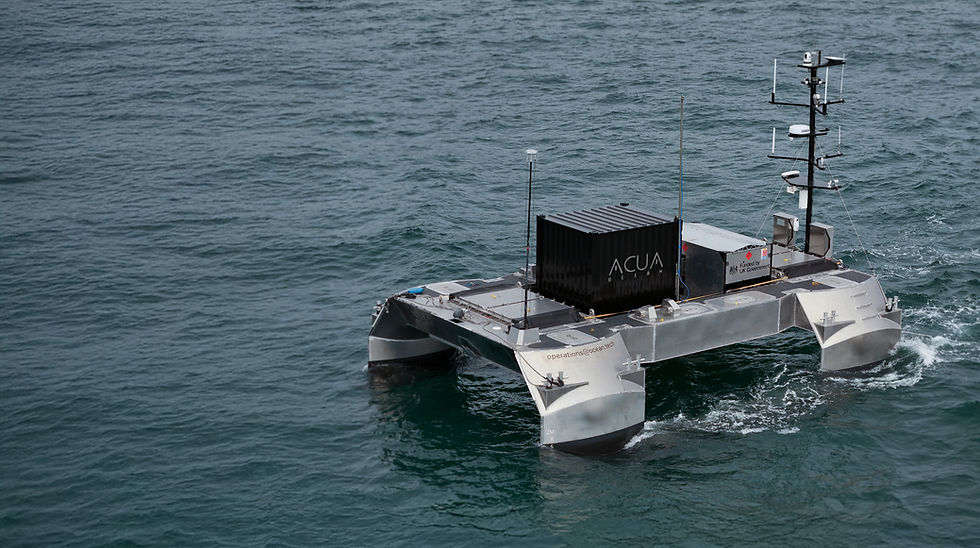
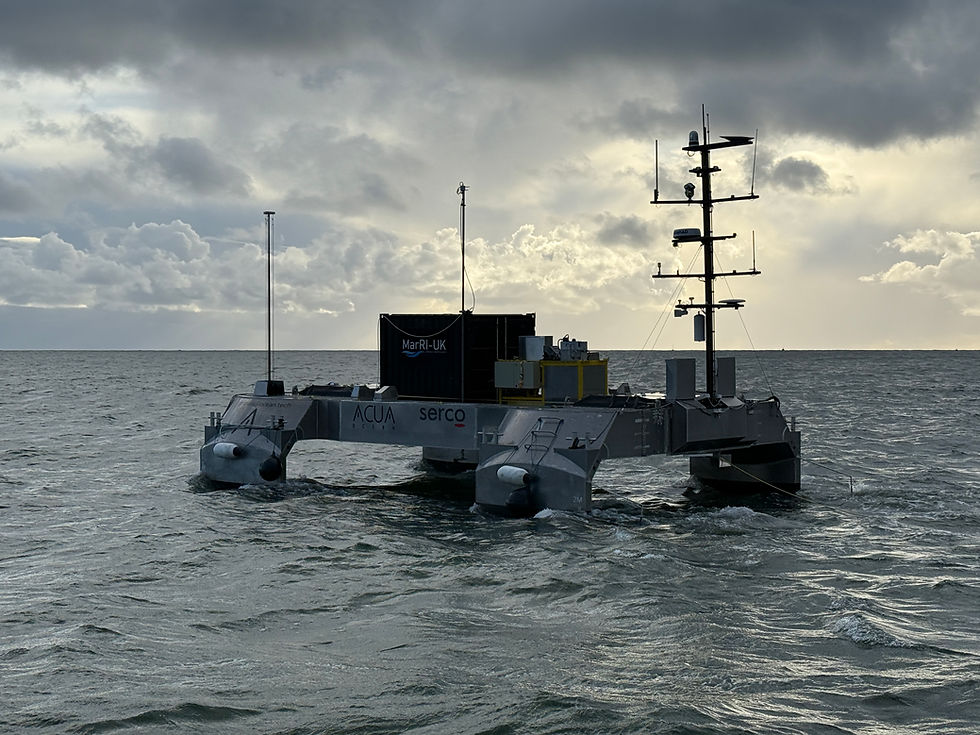
Uncrewed surface vessels (USVs) offer a fundamentally different operational and cost structure. ACUA Ocean’s USV Pioneer can operate for up to 50 days at sea at an average speed of 6.5 knots, delivering offshore monitoring capability at approximately 60% lower cost than a comparable 40-45 m crewed vessel. Because the vessel is uncrewed, staffing requirements are significantly reduced: two operators can manage an eight-hour shift, and a team of nine personnel can safely operate three to four vessels concurrently, creating substantial economies of scale.
The USV Pioneer can deploy more than four miles offshore within three hours, with case-by-case risk assessments enabling far-offshore operations supported within 24 hours where required. Beyond cost savings, this operational model helps address a growing crewing crisis in the marine sector, improves quality of life by reducing prolonged offshore rotations, and supports more sustainable career pathways for skilled mariners. Collectively, these factors make continuous, large-scale monitoring of high-seas MPAs operationally realistic for the first time, transforming enforcement under the BBNJ framework from an aspirational goal into an achievable outcome.
Addressing Illegal Fishing and Associated Abuses
Illegal, unreported, and unregulated (IUU) fishing remains one of the most significant threats to biodiversity within high-seas MPAs. Preventing these activities requires persistent presence, observation, and timely reporting. The USV Pioneer can operate continuously under the supervision of a trained remote crew, enabling suspected illegal activity to be detected, documented, and reported directly to relevant authorities.
This represents a step change in high-seas protection. Areas that would be prohibitively expensive to monitor using crewed vessels can instead be maintained under continuous observation. Activities can be rapidly observed and relayed, reducing the time between illegal activity and enforcement action, while providing evidentiary data—such as vessel identification and operational behaviour-to support prosecution. Persistent monitoring may also aid in detecting human trafficking and labour abuses, which are frequently associated with vessels engaged in illegal fishing.
Research and International Cooperation
A central strength of the BBNJ Agreement is that it embeds international scientific research and cooperation directly into high-seas governance. Rather than relying on nationally siloed research efforts, the treaty establishes formal mechanisms for collaboration, including a Scientific and Technical Body to support evidence-based decision-making and a Clearing-House Mechanism to facilitate data sharing, capacity building, and technology transfer.
This framework enables researchers from different countries and institutions to contribute data, expertise, and infrastructure toward shared conservation objectives, while ensuring that benefits-such as access to data, analytical tools, and training—are distributed more equitably, particularly to developing states. By aligning global observing systems, biodiversity databases, and research programmes under a common governance structure, the treaty reduces duplication, improves transparency, and allows science to directly inform the designation, monitoring, and management of high-seas MPAs.
Integrating Enforcement and Research
Delivering this model of international partnership requires shared research infrastructure and platforms capable of operating reliably across a distributed network of protected areas. In this context, uncrewed surface vessels such as the USV Pioneer provide a practical mechanism for integrating enforcement and research within a single operational platform.
Unlike smaller, task-specific USVs, the USV Pioneer is designed to support a diverse suite of scientific sensors alongside monitoring systems, enabling simultaneous data collection during routine patrols. The platform provides approximately 1 kWh of continuous power over deployments of up to 50 days, supporting the operation of water-column chemical sensors, passive acoustic monitoring for wildlife, camera systems, and the collection of water samples for environmental DNA (eDNA) analysis. In addition to water-based sensors, the platform can carry and relaunch aerial drones, for data collection across even larger areas, and remote reconnaissance tasks. This dual-use capability allows enforcement-focused operations to generate high-value scientific data from some of the most remote and under-sampled regions of the ocean.
Conclusion
Overall, the BBNJ Agreement establishes not only a pathway for large-scale protection of the high seas, but a foundation for sustained international collaboration in research, monitoring, and conservation. Effective implementation will depend on access to platforms capable of operating safely, persistently, and cost-effectively in remote environments. USVs offer a scalable and practical solution to this challenge, supporting both the governance objectives of the treaty and the scientific knowledge needed to underpin long-term conservation outcomes.
References
Pew Bertarelli Ocean Legacy, 2025. By connecting marine protected areas, policymakers can improve ocean health. Fact Sheet, 29 April 2025. Pew Bertarelli Ocean Legacy. Available at: https://www.pew-bertarelli-ocean-legacy.org/en/research-and-analysis/fact-sheets/2025/04/30/by-connecting-marine-protected-areas-policymakers-can-improve-ocean-health?utm_source=chatgpt.com
Jones, P.J.S., Claudet, J., Kittinger, J.N. and Gaines, S.D., 2022. Ocean conservation boosts climate change mitigation and adaptation. One Earth, 5 (10), pp.1126–1138. doi:10.1016/j.oneear.2022.09.002
Lynham, J.M. and Villaseñor Derbez, J.C., 2024. Evidence of spillover benefits from large-scale marine protected areas to purse seine fisheries. Science, 386(6727), pp.1276–1281. doi:10.1126/science.adn1146.
Jacquemont, J., Blasiak, R., Le Cam, C., Le Gouellec, M. and Claudet, J., 2022. Ocean conservation boosts climate change mitigation and adaptation. One Earth, 5(10), pp.1126–1138. doi:10.1016/j.oneear.2022.09.002.
Lenihan, H.S., Gallagher, J.P., Peters, J.R., Stier, A.C., Hofmeister, J.K.K. and Reed, D.C., 2021. Evidence that spillover from marine protected areas benefits the spiny lobster (Panulirus interruptus) fishery in southern California. Scientific Reports, 11, article number 2663. doi:10.1038/s41598-021-82371-5.
Costello, M.J., 2024. Evidence of economic benefits from marine protected areas. Scientia Marina, 88(1), e080. doi:10.3989/scimar.05417.080. Available at: https://scientiamarina.revistas.csic.es/index.php/scientiamarina/article/view/5526
Comments